

Intercom Opens Fin to the World
The company behind the leading customer service AI is letting developers — and even competitors — build on top of its models

Three years after launching its Fin customer service agent, Intercom is opening it up to third-party developers via an API. There’s a catch: It’s open to anyone spending at least $250,000 on Intercom, but the company promises usage rates that are “by far the cheapest in the industry.”
Until today, Fin had been confined to the Intercom platform. Approximately 8,000 companies use it today, and it resolves two million customer issues each week. Yet developers clamored for more, which is what led Intercom to release its Fin API, paving the way for AI-powered support to be added to any platform or product. And now, there’s the Fin API Platform, a solution for companies looking to build hyper-specific and specialized agents.
Disclosure: I used to work at Intercom as a senior editor. This post is based solely on public information and my independent analysis. The company did not influence or compensate me to write about this news.
The Fin API platform comes with four API feeds: Fin Apex, RAG, Retrieval, and Reranker. Together, they provide developers with a comprehensive, modular AI answer engine for a variety of use cases.
Fin Apex API
The Fin Apex API grants programmatic access to the “core” of Fin, a model purpose-built specifically for customer service. Intercom created Apex in-house using an undisclosed open-weights foundation and post-trained on proprietary data. Its second-generation LLM was released last month, and the company claims it outperforms OpenAI’s GPT-5.4 and Anthropic’s Claude Sonnet 4.6 in resolution rate (2.8 percent higher), hallucinations (65 percent fewer than Sonnet 4.0), and speed (0.6 seconds faster time-to-first-token).
Being able to tap into Fin Apex ensures that customer service apps and agents will have fewer hallucinations because they’re basing responses on proven domain-specific data.
Fin RAG API
For developers who want a comprehensive answer-generation experience without manually assembling components, Intercom offers an out-of-the-box solution with its Fin RAG API. Included are Fin’s complete retrieval-augmented generation pipeline, including the Fin Apex 1.0, Fin Retrieval, and Fin Reranker models. All it takes is one API call to trigger the search-filter-generate sequence.
Intercom claims the API resolves 67 percent of customer questions without human intervention on average, rising to 84 percent among the top 10 percent of deployments.
Fin Retrieval API
If developers just want to incorporate Fin’s search capability, this API will be useful, especially if lying on top of a third-party language model. Intercom describes it as a custom retrieval model optimized for custom service use cases, with a carefully balanced tradeoff between efficiency and quality. The company reports it delivers 20 percentage points higher precision than Voyage-Large-3, one of the leading embedding models used in enterprise RAG systems.
Fin Reranker API
The last component is designed to resolve a pain point in AI search: how to surface the right answer at the top of the results list. The Fin Reranker API gives developers access to Fin’s reranking capability, which sorts candidate results by relevance and is optimized for an LLM’s context window. Ensuring that results are efficiently ranked improves them, saving time, cost, and energy. And, similar to the Retrieval API, developers can use the Reranker API individually, meaning this tool can be dropped into existing RAG pipelines without needing to use the entire Fin API platform stack.
Initially, Intercom expects its Fin API to be used not only for custom agents but also for vertical-specific agents across industries such as hospitality, healthcare, and logistics. That said, the company is optimistic about Fin-powered startups emerging in what it calls “hyper-specific” fields like dentistry and car dealerships.
Intercom is even willing to license Fin Apex and its platform to competitors—Decagon, Sierra, Zendesk, and others—a rare and pointed overture in an increasingly crowded market.
From ‘Bleak’ to Remarkable
Intercom was one of the first companies to capitalize on using AI in customer service. Chief Executive Eoghan McCabe, in March, revealed that his company’s future was looking “pretty bleak,” due to the impact of rising interest rates, which also greatly affected many SaaS companies. The introduction of ChatGPT prompted (no pun intended) Intercom to pivot quickly, and Fin was born. “Our business began to violently recover thereafter,” McCabe writes.
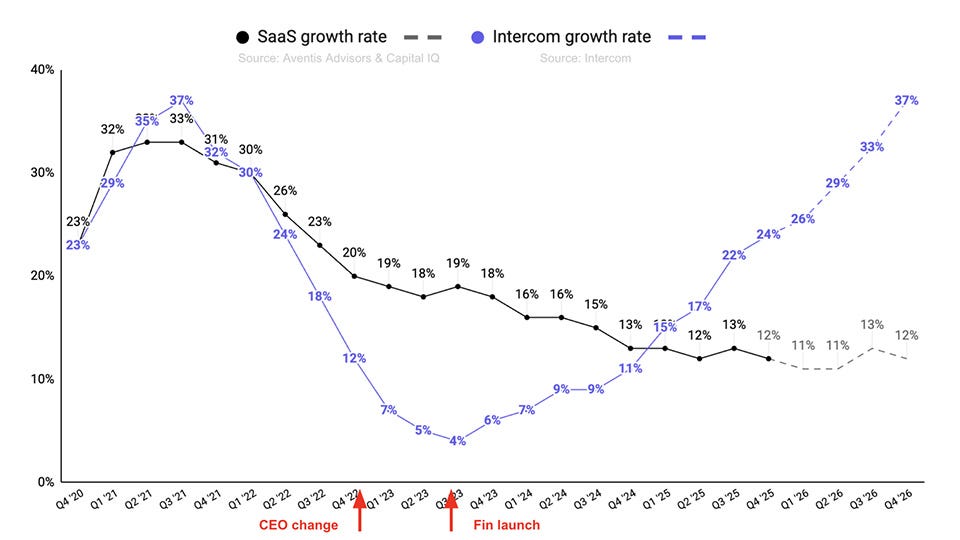
The team recognized that it had stumbled onto something, and Intercom’s monthly growth rate changed course from as low as four percent to perhaps over 37 percent. It’s in stark contrast to the rest of the SaaS industry, which is seeing growth rates at around 12 percent. McCabe states Intercom made significant investments in its AI strategy, ripping up old values, rewriting its mission to focus on agent goals, and having its refounding moment. It also shifted 80 percent of its research and development dollars to Fin and aggressively grew its AI team from six to 60 people in three years.
“In a world of agent abundance, the workflow tools sold by our industry are clearly far less important and also must drastically change,” McCabe explains. “Agents don’t need workflow tools, and the humans working with the agents need different tools too. The tough pill you must swallow is that if you can’t become an agent company, your CRUD app business has a diminishing future.”
The bet on Fin appears to be paying off. Intercom now generates $400 million in annual recurring revenue, $100 million of which flows directly from Fin.
Very interesting approach from Intercom. It's clear that they've had a turnaround and they've clearly found something that works; however, do I understand it correctly that in the last line, when you said that only 25% Of their revenue comes from their AI agent - so they've had a massive turnaround, which is attributed to their AI-first approach, but only 25% of that revenue is coming from the AI agent itself?