

Your AI Agent Is Only as Good as Your APIs
Irish startup Jentic is doing the unglamorous work that makes enterprise AI actually function—and it starts with your infrastructure

The agents are ready. The pipes aren’t.
That’s the uncomfortable reality sitting underneath the AI agent boom. Enterprises are racing to deploy AI agents that can book flights, resolve customer complaints, reroute shipments, and connect systems that may have never spoken with each other before. The capability does exist. But the moment an agent takes action, it runs into the same unglamorous problem every time: the APIs it’s dependent on weren’t built to accommodate it.
They were built for humans.
It’s a distinction that holds more significance than you might think. “When you’re developing for humans, you can cut a lot of corners. You don’t document things properly [or] your APIs get too complicated. But it doesn’t matter because someone is going to sort that out at some point. The workflow…is like the code that they do, and it all kind of works, and everyone’s happy,” Michael Cordner, co-founder and chief technology officer at Jentic, tells The AI Economy. “For AI agents to be useful, you can’t skip though, you can’t cut those corners anymore. You need to make sure your documentation is in place, your API is well designed.”
This is where Jentic believes it has a role to play, transforming companies and their legacy systems into agentic enterprises. Founded in 2024 by Cordner, former Rent the Runway executive Dorothy Creaven, and DemonWare co-founder Sean Blanchfield, this Irish startup works with a business’s internal APIs and infrastructure to make sure they can be used by AI agents.
“A lot of enterprises will have their own bespoke solutions or APIs that they actually don’t have much integration with,” Creaven, Jentic’s chief operating officer, says. “I think that’s really where the value is. We’re connecting everything together without having to create a complete sovereign data stack. It’s actually making it operational across lots of applications and tooling.”
Jentic’s Origin Story
The AI Economy sat down with Creaven and Cordner last December on the sidelines of AWS re:Invent in Las Vegas. The company had participated in AWS’s Generative AI Accelerator program—one of only eight European startups chosen, and the only one from Ireland. At the time, the founders explained that they were aiming to sign new customers and seek out potential design partners.
Disclosure: I attended AWS’ 2025 re:Invent as a guest, with a portion of my travel expenses covered by the company. However, Amazon did not influence the content of this post—these thoughts are entirely my own.
According to Creaven, the idea behind Jentic came from Chief Executive Blanchfield, who one day wondered how enterprises would adopt AI “in a very real way.” Initially, the company focused on being an “integration layer for agents,” centralizing all the APIs and authentication in one place for bots to call and access. “Software companies are built on APIs, right? Applications are APIs. Tools are APIs. What we’re doing is creating that communication layer where it can actually connect the API layer with the AI layer.”
But don’t applications like Salesforce, Microsoft, ServiceNow, Box, Zendesk, HubSpot, Workday, SAP, Slack, Twilio, DocuSign, and Stripe already have some integration with AI agents? Yes, however, that’s not the space Jentic wants to play in. “Our focus right now is not on SaaS APIs because we think that’s a game that’s going to get messy and protectionist,” Cordner states. Rather, Jentic has set its sights on legacy systems, such as enterprise resource planning apps, reservation systems, supply chain and logistics platforms, internal Kubernetes clusters, CI/CD pipelines, internal single sign-on systems, custom ticketing systems, on-premise email servers, and more.
“The hard part is the back end,” Cordner emphasizes. “The hard part is making sure your systems and data are well enough presented.”
He’s skeptical about how companies are approaching their AI integrations, arguing that the order of operations is being reversed—leaders are being seduced by what AI can do before sorting out whether their systems are actually ready for it. Cordner argues that “99 percent” of the work deploying AI agents is traditional software engineering. “You need to make sure that your existing systems can meet AI in order to make it useful,” he says. “A lot of other companies out there that have just started with AI, go ‘this is great, look what’s happening here’ and then started to advocate really weird things—’replace all of your APIs with MCP’—which is nuts.”
How Jentic Works
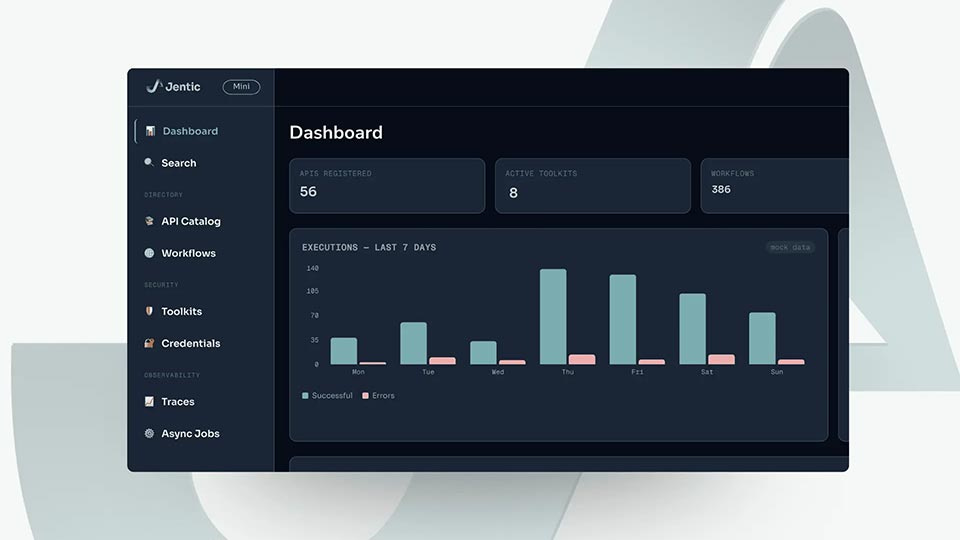
What Jentic does is score an API across six dimensions to determine how useful it is to AI. If the API is properly documented, a virtual sandbox is created, allowing developers to experiment with it. Cordner explains that once the API is clean and accessible, agents can be given a task and left to figure out how to complete it. The bot may even try different combinations of API calls until it finds a path that works.
At this point, Jentic is monitoring the AI, recording which APIs were called, the order in which they were called, and how the task was completed. This data is used to create a fixed, reusable workflow, so the next time someone needs to do the same task, Jentic will match it to the existing workflow and run it deterministically.
And because these templated workflows are built on Arazzo, the open standard from the same initiative behind OpenAPI, they’re easily reproducible. “We think everything should be out in the open,” Cordner declares. “There should be no walled gardens around this.”
Embracing closed-source is what “all of our competitors are doing,” Creaven adds, while remarking that such walled garden approaches limit the number of APIs that can be connected to AI.
So committed to open source is Jentic that it hired Frank Kilcommins—the originator of the Arazzo spec—as its head of enterprise architecture, along with a few developers from the OpenAPI initiative. The startup is also “augmenting” open and published SaaS specs by adding missing security information, descriptions, and documentation to help the broader community improve the quality of SaaS APIs.
Jentic has grown to more than 22 employees in Dublin and has raised four million euros ($4.6 million) in what Creaven describes as Ireland’s largest pre-seed round, led by Elkstone Capital Partners.
How Ready is Your API?
Along with its participation in AWS’s Generative AI Accelerator program, Jentic debuted its AI Readiness Scorecard, an automated assessment tool to “pinpoint where and why enterprise AI pilots fail.”
“AI pilots work in narrow test cases, but hit a wall when it comes to real systems. It’s garbage in, garbage out: weak API foundations lead to unpredictable agents,” Blanchfield says in a release. “We built the AI Readiness Scorecard to help enterprises survey their entire API estate, see exactly where the weaknesses are, and get a practical, actionable path to making them AI-ready.”
In its initial edition, Jentic reveals that among the 1,500 APIs it analyzed, there were common gaps that block full AI integration. First, many APIs didn’t specify where they are hosted. Next, authentication details were missing from specifications—they were listed in human documentation instead. Many of the APIs also didn’t conform to OpenAPI specs (e.g., broken references and malformed schemas). Lastly, some APIs were missing the required path parameters.
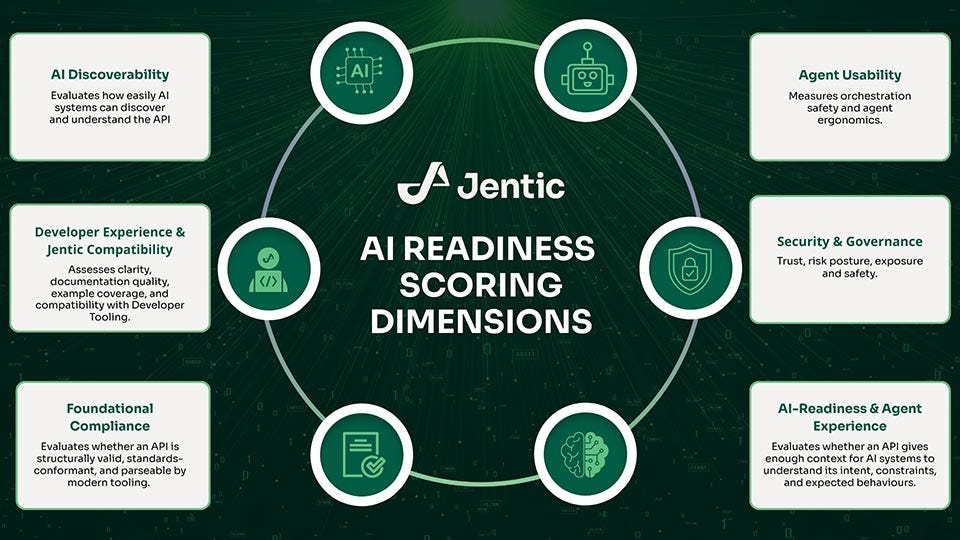
Developers can try it out for themselves. On Jentic’s website, they need only upload their OpenAPI file (JSON or YAML supported) or submit a URL to the scorecard to find out how ready their API is. The tool will then evaluate its quality, security, and semantics using six dimensions: foundational compliance; developer experience and Jentic compatibility; AI readiness and agent experience; agent usability; security and governance; and AI discoverability. It will also provide recommendations for improving the API and steps to make it ready for agents.
When asked which API was top-performing, Creaven and Cordner disclosed that it was Jentic. “Not because we designed the spec to fit it,” Cordner quickly states. “We did the scorecard, and then we ran our API through it.” Notably, the score wasn’t great, so the team adjusted the specifications to align with the scorecard’s recommendation.
Cordner hopes that this will motivate developers to be more diligent in making APIs better, ensuring they are properly documented, have descriptive names, short parameters and structures—”basically good engineering practices that tend to get ignored over time.”
“Pretend you’re documenting it for…someone who’s never seen code before. You’re documenting it for them, and then you’re…a good way there towards having it ready for AI,” he says.
Making OpenClaw Agents Smarter
Recognizing the coming agentic evolution, Jentic is already working to ensure the next-generation bots are capable. This week, the company launched Jentic Mini, an AI-curated catalog of more than 10,000 APIs and workflows, with fine-grained permissions, minimal credential risk, and a kill switch. The idea: Ensure that if enterprises adopt sophisticated OpenClaw-like agents, they perform as expected and that company data is protected.
In a statement, Blanchfield writes that “the next era of software will not be built for humans. It will be built for agents, by agents. Jentic Mini gives developers a free, open source foundation for that shift, connecting general-purpose agents to real systems…”
OpenClaw’s appeal is that it’s a universal agent we’ve been looking for. And it’s only been around for a few weeks. But this open-source framework is not without risks—it’s been labeled a security nightmare, with many fake instances on GitHub, data leaks, vulnerabilities to prompt-injection attacks, and exposed instances. Despite this, the technology is starting to catch on, with new variants in the so-called Claw family springing up, including one from Nvidia, NemoClaw, that reportedly fixes OpenClaw’s security woes.
In a way, OpenClaw seems to represent the type of powerful, general-purpose agent that Jentic has been building toward. It’s an autonomous agent capable of using APIs to complete tasks without human intervention. Jentic Mini is a collection of solutions to help OpenClaw agents not only access an organization’s systems but also prevent them from going rogue or leaking data.
Jentic Mini is free to use and open-source. Anyone can download the files and host them themselves. By doing so, the company is making it more accessible for developers while helping them move from pilot to real-world use, all while alleviating concerns about security, permissions, or control.
“We want to make it dramatically easier to deploy agents that do real work,” Blanchfield says.